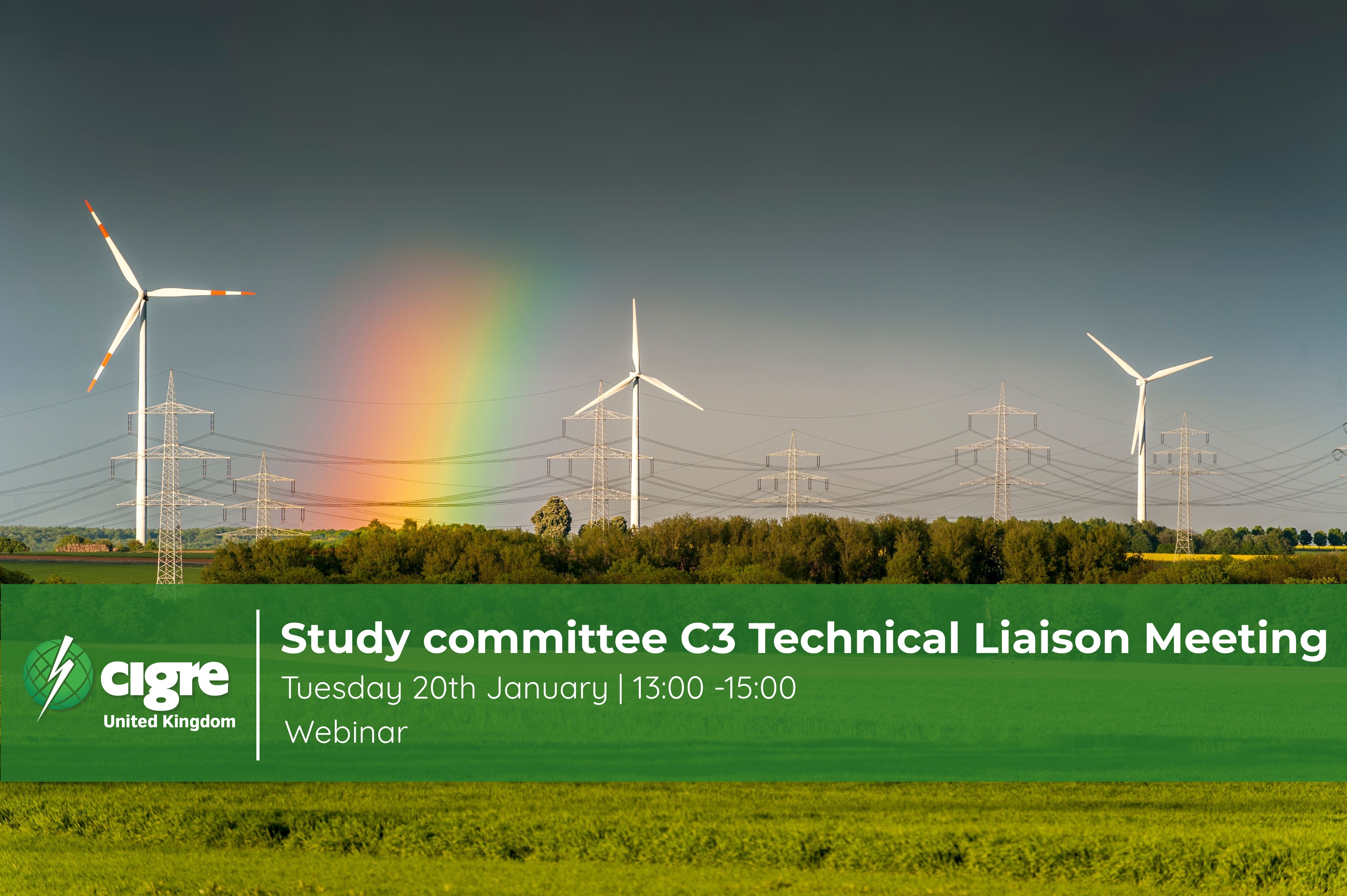
We are excited to invite you to attend a CIGRE UK Technical Liaison Webinar to understand the latest developments in Power System Sustainability and Environmental Performances. The meeting will be led by the CIGRE UK C3 Regular Member, Hayley Tripp.
EVENT DETAILS:
📅 Date: Tuesday 20th January 2026
🕐 Time: 13:00-15:00
📍 Location: Online Webinar
💳 Fee: Free of charge
Agenda
13:00 | Introduction & Welcome
13:05 | C3 Priorities and current working groups
13:20 | Update JWG C3/B2.24 Methods of reducing electrocution of birds from power lines – Brian McGowen, Scientias-Energy
The presentation will address the following points:
> the objectives JWG C3/B2.24 Methods of reducing electrocution of birds from power lines & our activity to date.
> Introduce and request support for the survey being distributed to utilities.
> Introduce bird mitigation measures relevant for UK/IE
> How to get involved!
13:45 | ICECREAM project (Investigating Coastal and Estuarine Climate Risks on Electricity Asset Management) – Aisha Ali, National Grid Electricity Transmission
This presentation is about ICECREAM (Investigating Coastal and Estuarine Climate Risks on Electricity Asset Management), a Network Innovation Allowance (NIA)-funded project led by National Grid Electricity Transmission. ICECREAM is one of the climate change resilience portfolio based innovation projects focused on climate resilience, aiming to assess and mitigate the long-term impacts of sea level rise, coastal erosion, storm surges, and salt marsh encroachment on critical electricity infrastructure.
The project targets substations and transmission towers located within 500 meters of the UK coastline. Using high-resolution LiDAR data, UKCP18 RCP8.5 climate projections, and Flood Map+ simulations, ICECREAM forecasts shoreline retreat, flood inundation, and corrosion risk up to the year 2100. Early findings indicate that dozens of substations and towers are at increasing risk, with projected shoreline retreat and flood depths placing several assets into high-risk categories within the next few decades. ICECREAM is structured into seven work packages, covering everything from predictive modelling of shoreline and flood risk to real-time monitoring using connected salinity, water level, and image sensors. These sensors are currently being deployed at five proof-of-concept sites to validate model outputs and inform a wider rollout strategy.
A key objective is to provide Ofgem and other stakeholders with clear, evidence-based assessments of which assets are most vulnerable, when they are likely to be impacted, and what mitigation strategies offer the best cost-benefit outcomes. The project outputs are being integrated into National Grid’s GIS platforms to support operational decision-making and long-term investment planning.
By combining cutting-edge environmental modelling with real-time data, ICECREAM is setting a new standard for how climate risk is assessed and managed across the UK’s electricity transmission network.
14:10 | Biodiversity Net Gain and Nature Based Opportunities in Energy – Andy Martyr-Icke, National Grid Electricity Distribution
National Grid Electricity Distribution (NGED) are pioneering a way to utilise unused land around sub- stations to help nature recover, create Biodiversity Net Gain credits and improve network resilience, all while saving money for our customers.
Andy Martyr-Icke will outline how this can be done and why it’s so important.
14:35 | Closing remarks and request for Working Group priorities
15:00 | End
REGULAR MEMBER

Dr Hayley Tripp is the Elected Regular Member of the CIGRE UK Study Committee C3. She is a Lead Environmental Engineer at National Grid, where she manages electric and magnetic field issues for the business. She is also a member of Advisory Group C3-1, and chair of the Electric Power Research Institutions P60 utilities committee and the Electricity Industries Mortality Study Steering Group. Hayley holds a degree in Biology and a PhD in Neuroendocrinology, focusing on the effects of electric and magnetic fields on human health. She is a member of the Royal Society for Biology, the IET and the IES.
SPEAKERS
Andy Martyr-Icke has over 38 years’ experience in the electricity industry after joining aged 16 as an apprentice overhead linesperson. Since then, Andy has moved through management and engineering roles until moving into the environment sector in 2009. He is now Lead Environment Officer at National Grid Electricity Distribution (NGED).
Andy has worked in all areas of environmental sustainability, including waste, biodiversity, decarbonisation, EVs and environmental training. Andy is also working to eradicate PCBs from the UK’S energy networks as Chair of the Energy Network Association’s PCB Strategy Group.
In what spare time he has Andy enjoys time with his wife, two young adult children and rescued ex-racing greyhound, walking, cycling, going to the gym and continuing a 40 year-long love-hate (he loves it but his knees hate him for it) relationship with skateboarding.

Aisha Ali works within the Innovation Net Zero team at National Grid, focusing on the Resilience portfolio and driving sustainability across our operations. Aishas role centers on supporting the transition to renewable energy sources and enhancing the transmission infrastructure to enable efficient, low-carbon electricity delivery. Aisha collaborates with a wide range of stakeholders—including academic institutions, consultancies, and manufacturers—to identify challenges and co-create practical, scalable solutions that contribute to a more resilient and affordable energy system. With a strong interest in systems thinking and sustainable innovation, She aims to bridge technical insight with strategic impact. Aisha completed a Master’s degree in Sustainable Engineering at the University of Strathclyde in 2022, which deepened her understanding of the environmental, social, and economic dimensions of energy systems. Aisha is passionate about shaping a future where clean energy is accessible, reliable, and resilient for all.
Brian McGowan is an engineer with a passion for problem solving and creating value. Founded Scientias Energy in 2023 to serve the global power industry as an independent consultancy, after 27 years working in the industry in a variety of roles Research & Development, Project Management, Operations and Product Management. Expertise extends to design and development of composite insulators, polymeric arresters, heat shrink materials and wildlife and asset protection solutions and has been involved in wildlife and wildfire mitigation in our energy gird since 2008.
Brian is currently a member of the following technical working groups supporting the industry:
• Convener of CIGRE JWG1 C3/B2.24 Methods of reducing electrocution of birds on power lines.
• Member of IEEE P1656 Guide for testing the electrical, mechanical, & durability performance of wildlife protective devices on overhead distribution systems rated up to 38 kV
Other interests: Use of sensor technology in the grid ,composite components and use of non-destructive testing of utility wooden structures.
C3 – Power system sustainability and environmental performance
Mission
The mission of SC C3 is to facilitate and promote the principles of sustainable development in the field of power system performance through the global exchange of information and knowledge, generating added value by identifying best practices and developing recommendations in line with global best practices.
Scope
The scope of Study Group C3 covers the interactions between the natural and social environments and the end-to-end electricity system.
It involves addressing environmental and social impacts such as land use, biodiversity; greenhouse gases; air, soil, and water pollution; natural resource consumption; waste generation; electromagnetic fields; noise or landscape. It also considers the prominent role and relevance of different stakeholder groups, with a special focus on local communities.
The role of the power system in relation to the UN Sustainable Development Goals (SDGs) is also a field of work for SC3.
Working groups
View a list of CIGRE’s current working groups including for C3 here.
Publications
View all publications for Study Committee C3 on eCIGRE
Main areas of attention
Environmental & social impacts of power system development and operation with a life cycle approach (from cradle to grave, from planning to decommissioning).Identification, assessment, monitoring, and management of impacts. Mitigation and offsetting measures. Procedures, methodologies, and tools for quantifying, controlling, and mitigating the environmental impact such as life-cycle assessment (LCA), environmental product declarations (EPD), global benchmarking, etc. Risks assessment.
Sustainability: role of the power system. Anticipation to new trends and challenges.Impacts of relevant and emerging technologies (renewables, storage systems, hydrogen, new materials…); Climate change mitigation (decarbonization & Net Zero) and adaptation (risks & opportunities); New sustainability approaches: eco-design, eco-efficiency, circularity, supply chain management etc.
Stakeholders’ engagement and public acceptance
Effective communication and cooperation with the public and regulatory authorities to improve public acceptance of power system infrastructure and decision-making processes. Tools and engagement strategies.